
Pipe Rack Modules and Pre-Assembled Racks
From Spool to Tested System
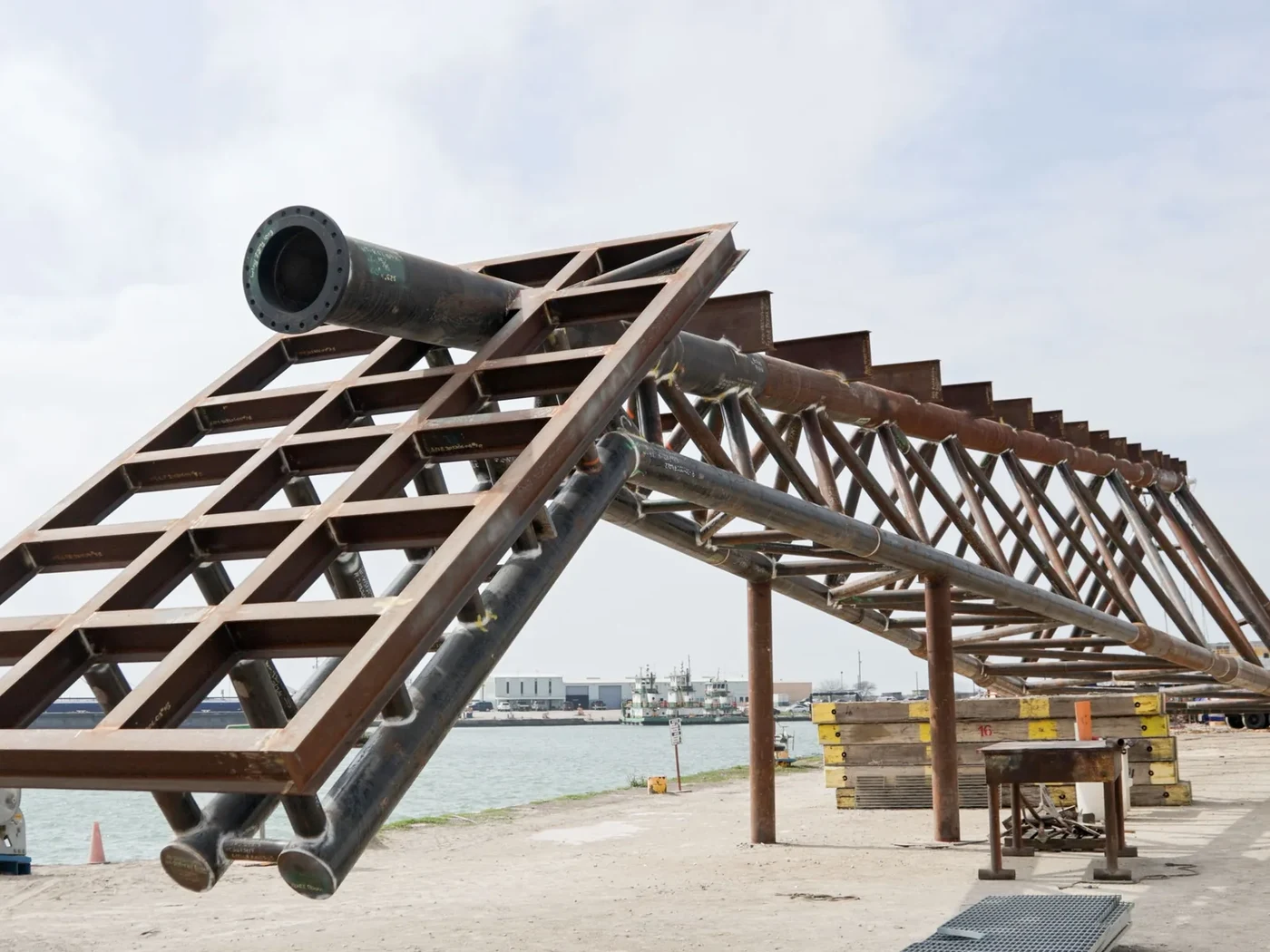
State Service Company fabricates pipe rack modules, also called pre-assembled racks or PARs, at a 70-acre waterfront yard in Ingleside, Texas. Racks are built with spools installed, welded into continuous systems and hydrotested before shipment, then delivered by barge in the erection sequence the site needs.

Modular Design
Engineered for transport, lift and field assembly.

Multi-Trade Integration
Pipe, cable tray, instrumentation and supports in one unit.

Lift & Transport Ready
Barge tie-down engineered in from the start.

Compliant & Certified
AISC structural, ASME B31.3 and B31.8 piping.

Quality Assured
Hydrotest, NDT and material test report documentation.

Field Support
Sequenced delivery and installation support.
How a Rack Is Built
A pipe rack is not steel with pipe laid in it. It is a working system that has to be assembled, joined and proven.
Pipe is cut, welded and coated to become a spool. Spools are joined into longer runs, set into the rack, then welded together so they become continuous lines and systems rather than loose sections. Each system is then filled with water and pressure tested in the yard to verify the integrity of the pipe and the joints across the whole run.
Everything in that sequence is field work if the rack ships as bare steel. Doing it in the yard means the welds are made at fixed stations by permanent crews, the tests are witnessed at ground level, and the rack that arrives on site is a tested system rather than a starting point.
Scope Carried in the Rack
- Structural steel fabricated to AISC standards
- Pipe spools installed, welded into continuous systems and hydrotested
- Cable tray, conduit and electrical distribution
- Instrumentation, tubing and supports
- Heat tracing where lines need to stay above temperature
- Insulation and coatings complete
- Fireproofing where specified
- Lift and transport engineering, including barge tie-down design
Barge tie-downs on these modules use two inch plate for the hold-down clips, which runs about 80 pounds per square foot. Transport loading is engineered into the rack from the start rather than added at load-out.
Sequenced to Your Erection Schedule
A rack that arrives out of order is a rack that sits in a laydown yard. State Service sequences fabrication and load-out to match the order the site will set them, so the crane picks follow the schedule instead of working around it.
On a large LNG pipe rack module project, one module section alone carried roughly 800 people working in the Ingleside yard. That work happens off the client site entirely. A facility of comparable scope built conventionally carries six to eight thousand people on site. See the yard.
Specifications
| Specification | Details | Notes |
|---|---|---|
| Maximum Module Length | Up to 400 ft (121.9 m) | Barge deck envelope |
| Maximum Module Width | Up to 125 ft (38.1 m) | Barge deck envelope |
| Module Height | No vertical restrictions | Direct barge load-out, no overpass or bridge limits |
| Load-Out Capacity | 8,000+ tons | Across 2,000 linear ft of load-bearing bulkhead |
| Oversize Modules | Transit offshore | Units exceeding Intracoastal limits route through open water |
| Minimum Access Water Depth | 16 ft | 12 miles to the Gulf of Mexico |
| Design Codes | ASME B31.8, AISC 360, ASCE 7 | Other codes per project |
| Structural Steel Standards | AISC, ASTM A36/A572 Gr. 50 | Other grades per project |
| Piping Standards | ASME B31.3 / B31.8 | Materials per project |
| Welding Standards | AWS D1.1 / ASME Section IX | Qualified procedures |
| Coatings & Finishes | SSPC-SP6 / NACE No. 2 | Per project specification |
Frequently Asked Questions
What is a PAR?
PAR stands for pre-assembled rack. It is a pipe rack fabricated off site as a complete module, with pipe, cable tray and supports installed, rather than erected piece by piece in the field.
How large a pipe rack module can State Service ship?
Size is governed by the barge envelope rather than road permits, because racks load out across the bulkhead directly onto a barge. The envelope is 125 ft by 400 ft by 22 ft. Racks too large for the Intracoastal Waterway transit offshore in open water.
Are the pipe systems tested before shipment?
Yes. Spools are welded into continuous lines inside the rack, then each system is filled with water and pressure tested in the yard before the module ships.
Can State Service fabricate spools without the rack?
Yes. Pipe spool fabrication is available standalone, with full NDT, hydrotest and material test report documentation, or bundled into a rack package.
Does the rack ship with electrical and instrumentation installed?
Yes. Cable tray, conduit, electrical distribution, instrumentation and tubing are installed in the yard as part of the module scope.
Let's build your next project together.